the quiet appeal of columnar apples
The house came with a black metal fence along its south side. Shortly after we moved in, I added a low raised bed beside it and planted raspberries to soften the structure. That worked well enough for a time, but eventually I found myself wanting something a little taller in that spot, something compact, and in keeping with the kitchen garden nearby.
When I came across columnar apples at Raintree Nursery in Morton, Washington, they seemed just right for that spot.
Columnar apples are bred to grow upright and narrow, bearing their fruit close to the main stem rather than spreading outward into a broad canopy. Raintree describes them as well suited to patios, containers, and small garden spaces. The trees generally reach 8 to 10 feet tall, depending on variety and rootstock, and stays no more than 2 to 3 feet wide.
I chose four varieties to span the 13-foot length of that fence: Scarlet Sentinel, Golden Sentinel, Tasty Red™, and Golden Treat™. The Scarlet Sentinel bears red apples with a classic McIntosh-style crunch, ripening in my yard in mid October. This is the last of the apples to be harvested. Golden Sentinel produces flavorful yellow apples that ripen early in my garden, often the first of the group to be harvested. Tasty Red is bright red, firm, sweet, and juicy. Golden Treat is a beautiful golden apple with a sweet flavor and ripening in early fall. The latter two are part of the newer Urban Apple® series, which Raintree describe as combining disease resistance, flavor, and ease of growing in small spaces.
The raised bed was constructed narrowly – about 18 inches on each side of the fence. So that ease of growing in small spaces certainly got my attention.
The trees arrived bare-root in mid-February. They were expected to fruit in two to three years, but they settled in quickly and began bearing right away. That first year, each tree must have held three or four dozen tiny apples. Because columnar trees fruit on short spurs along the main stem, it was not possible for all of them to size up well. The nursery advised thinning them to about a dozen fruits per tree, and so I found myself on my first, somewhat uncomfortable, fruit-thinning spree.
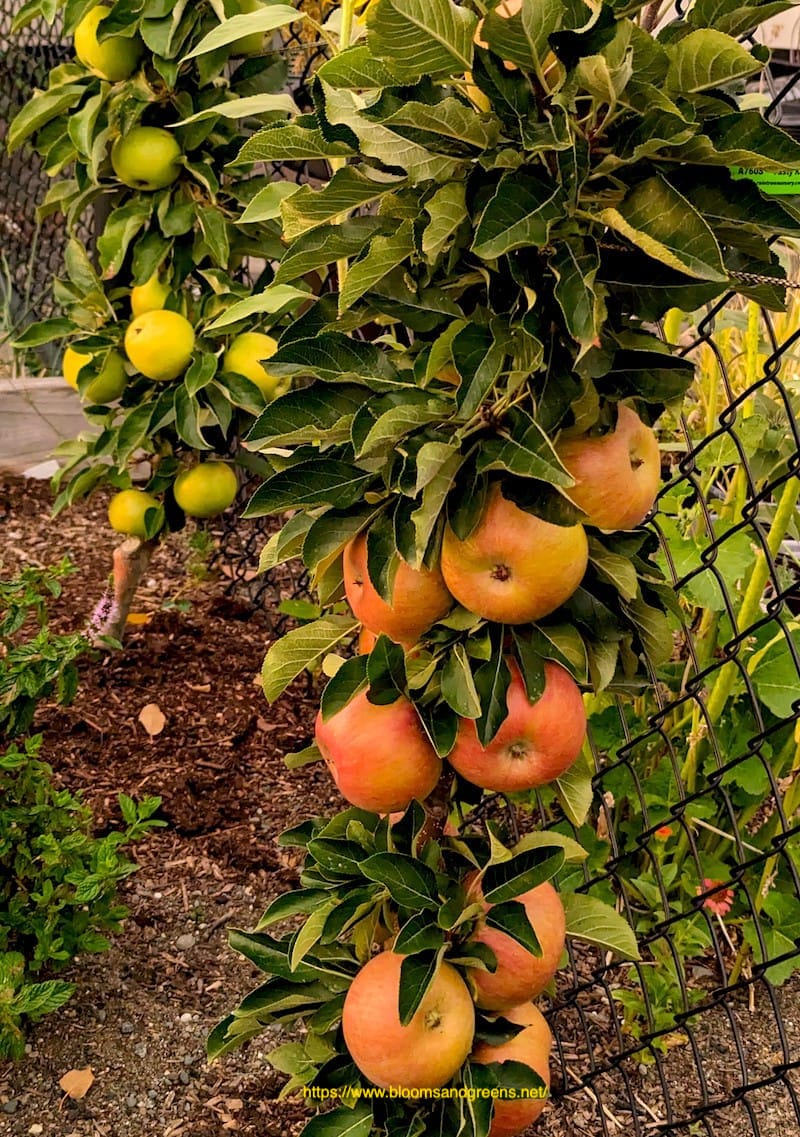
Other than that, mulching, and regular watering, they have not been fussy trees. Some fruit trees want to be the center of attention. Columnar apples do not. They tuck themselves neatly into a raised bed, stand politely beside vegetables and flowers, and ask only for sun, water, and a suitable companion for pollination. They gave structure without being overbearing. Over the past years, I've planted calendulas, nasturtiums, chives, sweet peas, sunflowers, dill, and mint (oh, dear!) with them. There is something very satisfying about a fruit tree that feels more companionable than a chore.
This week, I got four more bare-root columnar apples for the new raised beds: Blushing Delight, Tasty Red, Golden Treat, and Tangy Green, an Urban Apple with crisp texture, lime-green skin, and a sweet-tart flavor. The pairs will anchor each end of two 4-by-10-foot beds. If these trees start fruiting this year, I will likely thin out all but a couple of fruits so they can put more energy on root development.
For gardeners with limited space or limited patience for high-maintenance fruit growing, these columnar apples have a lot to offer. They are orderly, do not demand too much room, and, in my experience, deliver reliable fruits every year. There are, of course, a few things to keep in mind. Columnar apples still need full sun. They still need compatible pollination. And even where disease resistance is part of the package, resistance is not the same as immunity; conditions vary, and so do gardens. But in the three years I have grown these trees, I have had no real trouble with them except for one season when earwigs discovered them.
I am excited to have more of these trees in my garden, and that maybe the strongest endorsement I can give them.
🐝
Member discussion